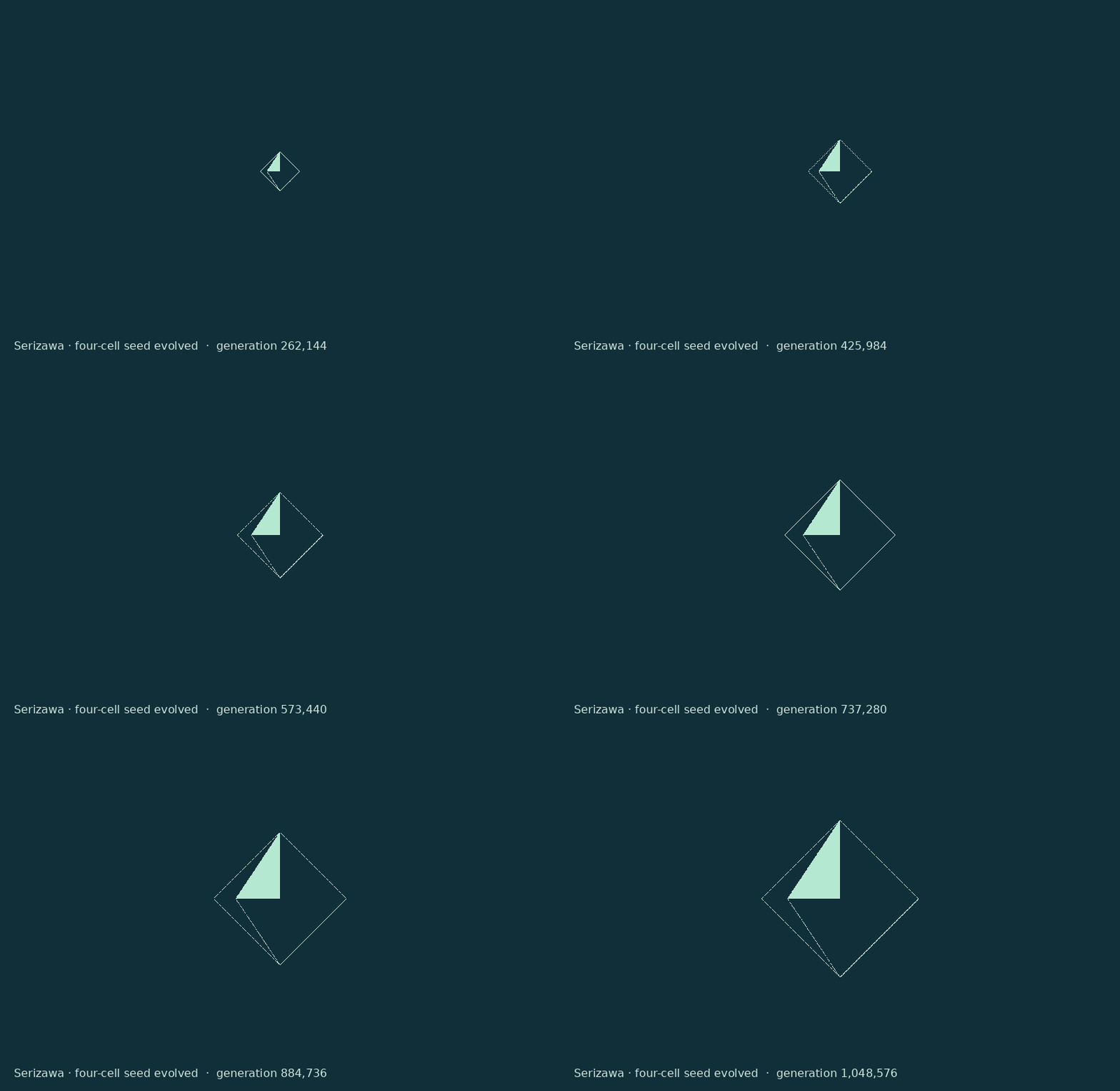
On March 23, 2014, I posted a working universal-constructor-based pattern in Serizawa. The announcement presented it as the first explicit working example of this kind in the rule, with an attached pattern and a Golly construction script.
Where my interest began
My interest in Conway’s Game of Life began with an article about Andrew Wade’s original Gemini, the self-constructing spaceship announced in 2010. Serizawa Geminoid was one of my first results after that introduction: I applied those construction ideas in another rule, making a much smaller, more efficient design.
This became a continuing line of work. I later built Geminoid Particles to explore construction and self-destruction in a rule of my own. Much later, I used the same construction technique in Remini, bringing it back into Conway’s Life with period-30 circuitry.
Construction encoded in signals
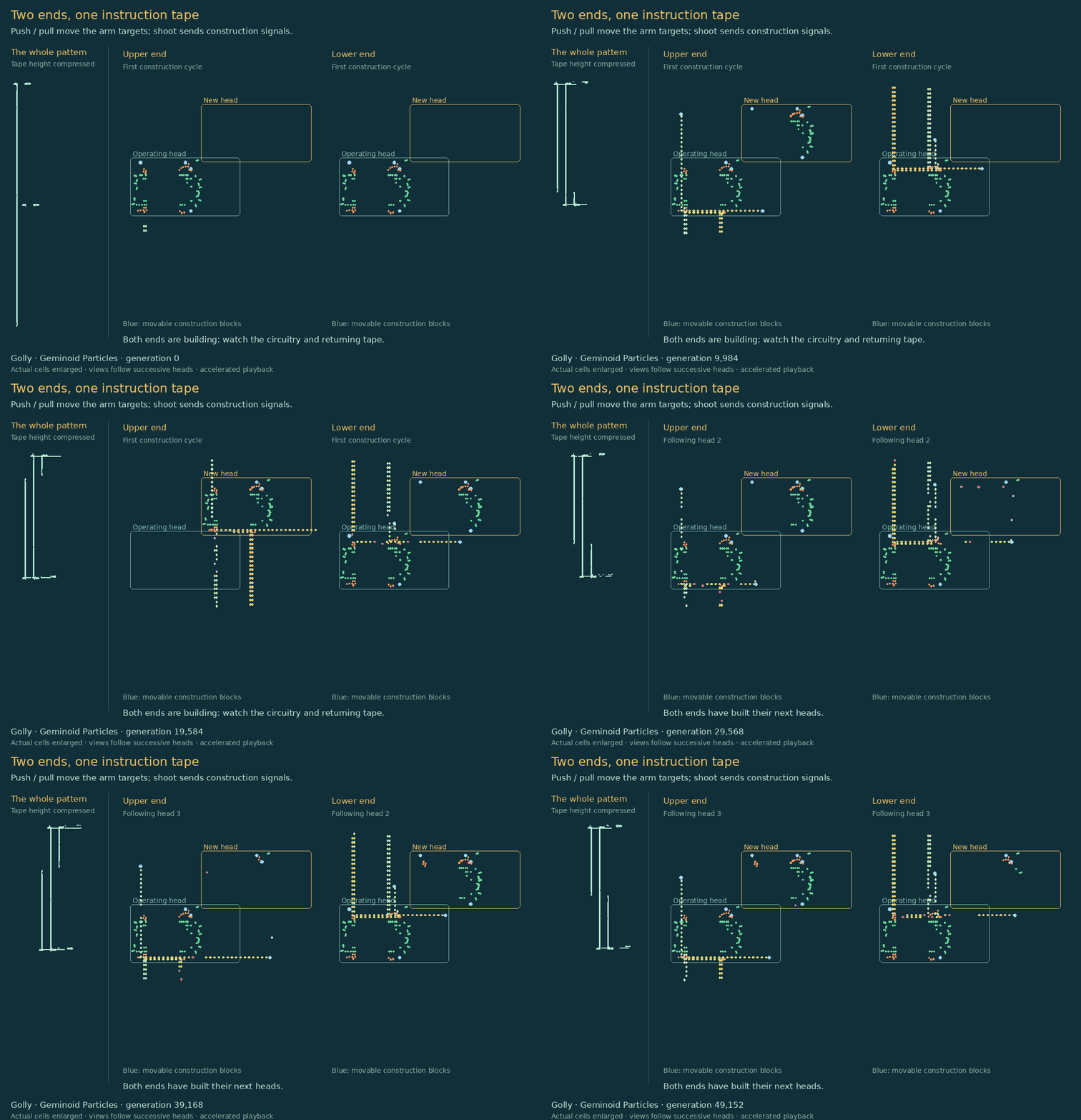
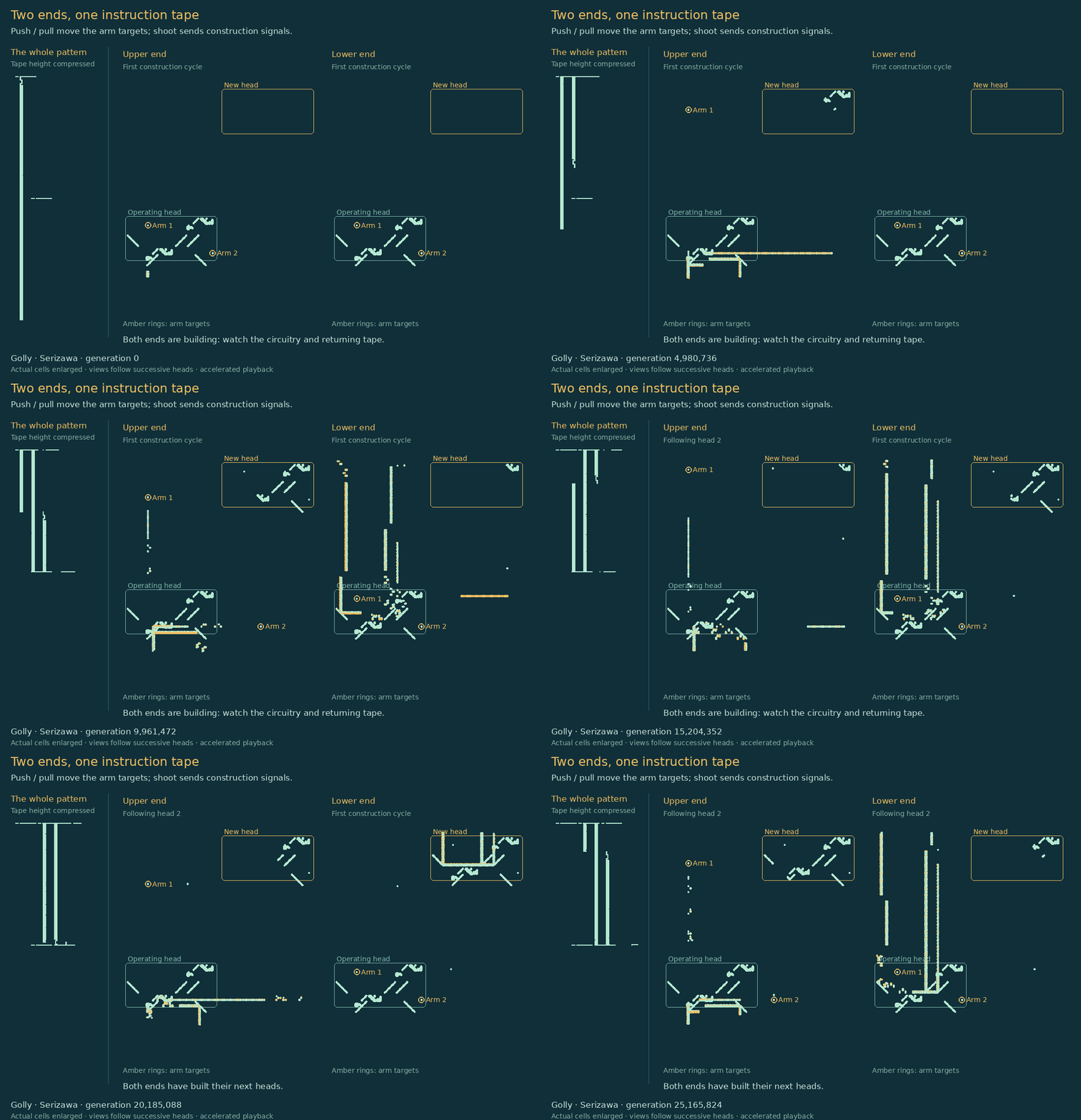
The animation shows both ends, including the lower end that a close-up of the first head leaves out. Each end builds its next head. The long instruction tape joins them, and the successive heads and changing routes give the construction its snake-like appearance.
The left panel shows the whole pattern with the tape’s height compressed. The two larger panels show the upper and lower ends at the same generation, following successive heads. The run continues to generation 25,165,824, beyond the first completed head so the other end can finish its circuitry too. Enlarged marks make the actual cells readable.
The tape supplies recipes to the construction arms: push and pull reposition their targets, and shoot sends a construction signal toward the new circuitry. The animation uses the complete original pattern in Golly; the end panels are views of that full simulation.
A closer view of the first two-arm construction
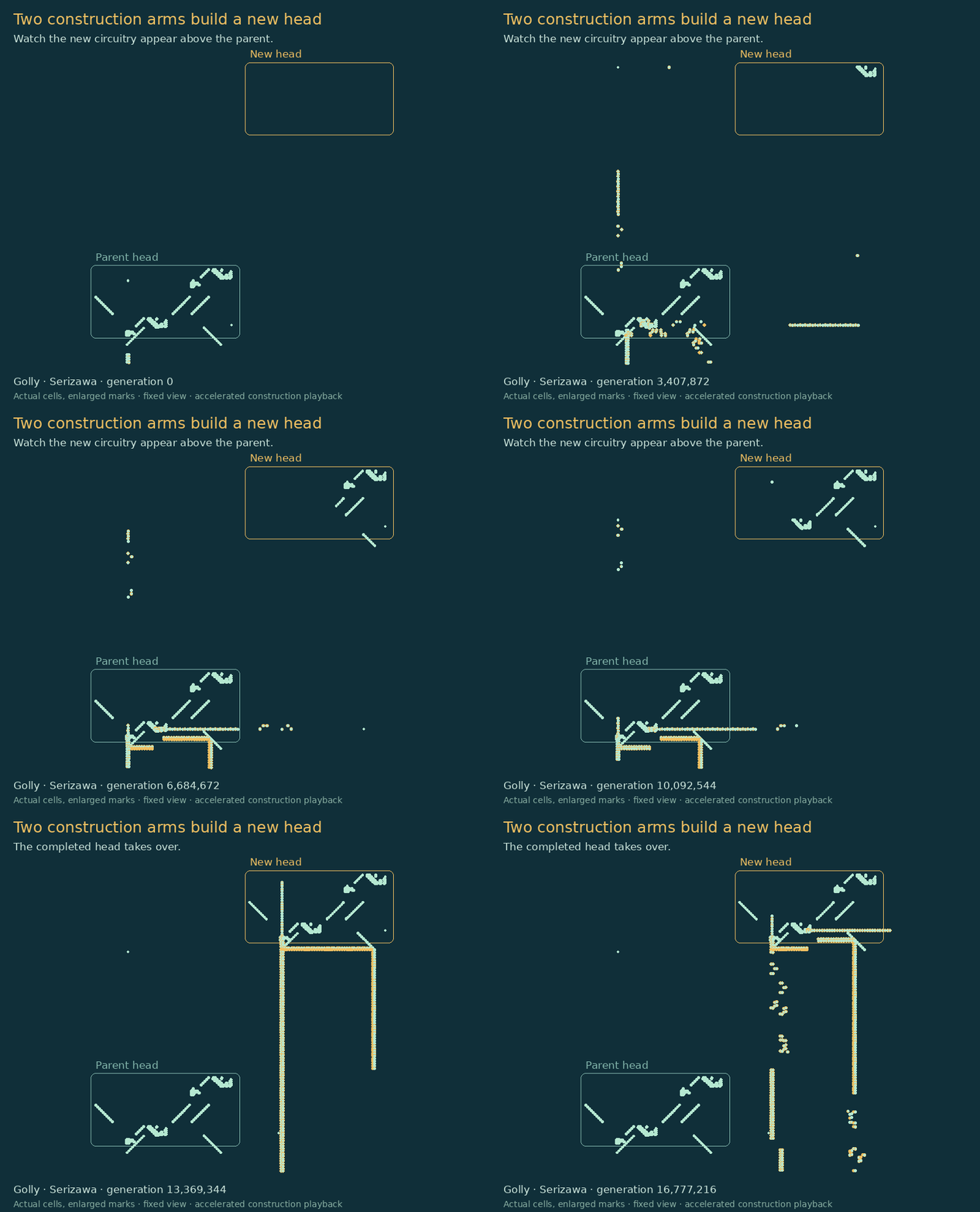
This closer view covers generations 0–16,777,216. It isolates the first end; the main animation above also includes the other end and the tape.
The reported cycle takes 13,362,290 generations, with a construction step of . Glider streams encode instructions for construction arms that build the next circuitry.
The significance is applying Geminoid construction principles outside Conway’s Life, using Serizawa’s own signals and reactions.
What “Geminoid” means here
I called the pattern a Geminoid and later described it as a linear self-replicator. Dave Greene distinguished it from a self-cleaning spaceship: the released construction leaves old circuitry behind and carries one copy of its instruction stream forward.
The thread therefore also describes it as a self-constructing puffer. Construction, copying the instruction stream, and destroying old machinery are separate tasks.
Connections
The discussion developed construction-arm recipes and explored transferring ideas between Serizawa and Life. This transfer between rules is the thread connecting Serizawa Geminoid, Geminoid Particles, and Remini. See also Serizawa quadratic growth.