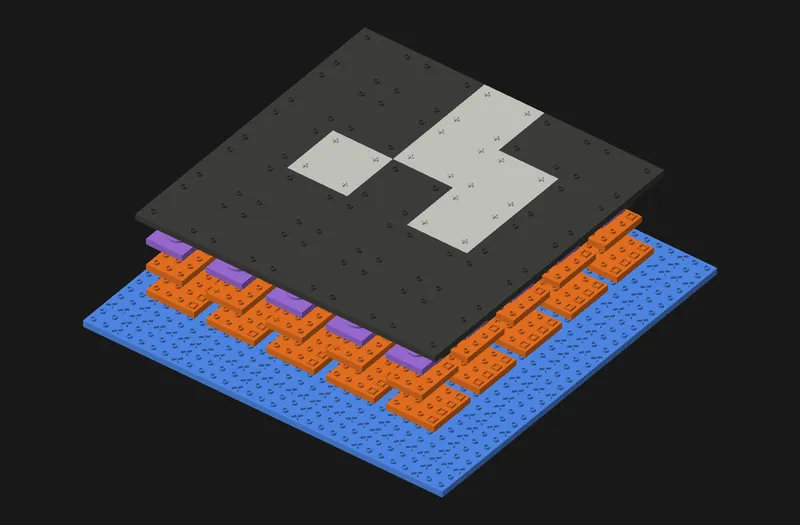
Remini, short for Retro Gemini, is a self-constructing puffer I assembled on April 14, 2019.
It continues a line of work that began when an article about Andrew Wade’s original Gemini drew me into Conway’s Life. One of my first results was Serizawa Geminoid, a smaller, more efficient construction in another rule. I then built Geminoid Particles; much later, I used the same construction technique for Remini with Life’s classic period-30 components.
Old circuitry, new understanding
I wanted to show how far our understanding of Life had progressed since Conway’s early construction ideas. Old, retro technology could now support a new self-construction design. The comparison mattered to me because the progress was visible even when the components stayed simple.
The breakthrough was realizing that period-30 glider streams could provide universal construction commands: push, pull, and shoot. Once I understood that, everything else felt straightforward.
In the original discussion, I clarified that my historical comparison was with the self-copying gun described in Winning Ways. The point was the gap in understanding, rather than a claim that the complete Remini had already been built on an early computer.
Push, pull, and shoot
An elbow is a small pattern used as the target of a construction arm. A recipe is a sequence of incoming gliders. Push and pull recipes reposition the elbow; shoot recipes produce an outgoing glider. Combining those operations lets a single input channel direct construction at different locations.
Modern construction with older components
It uses the single-channel, slow-salvo construction mechanism associated with the 0E0P metacell, but builds the machinery from classic period-30 circuitry rather than stable Spartan circuits.
Presence or absence of gliders in an intermittent period-30 stream provides enough control for a construction-arm elbow. The stream encodes instructions through its timing and gaps.
From still-life seeds to a gun array
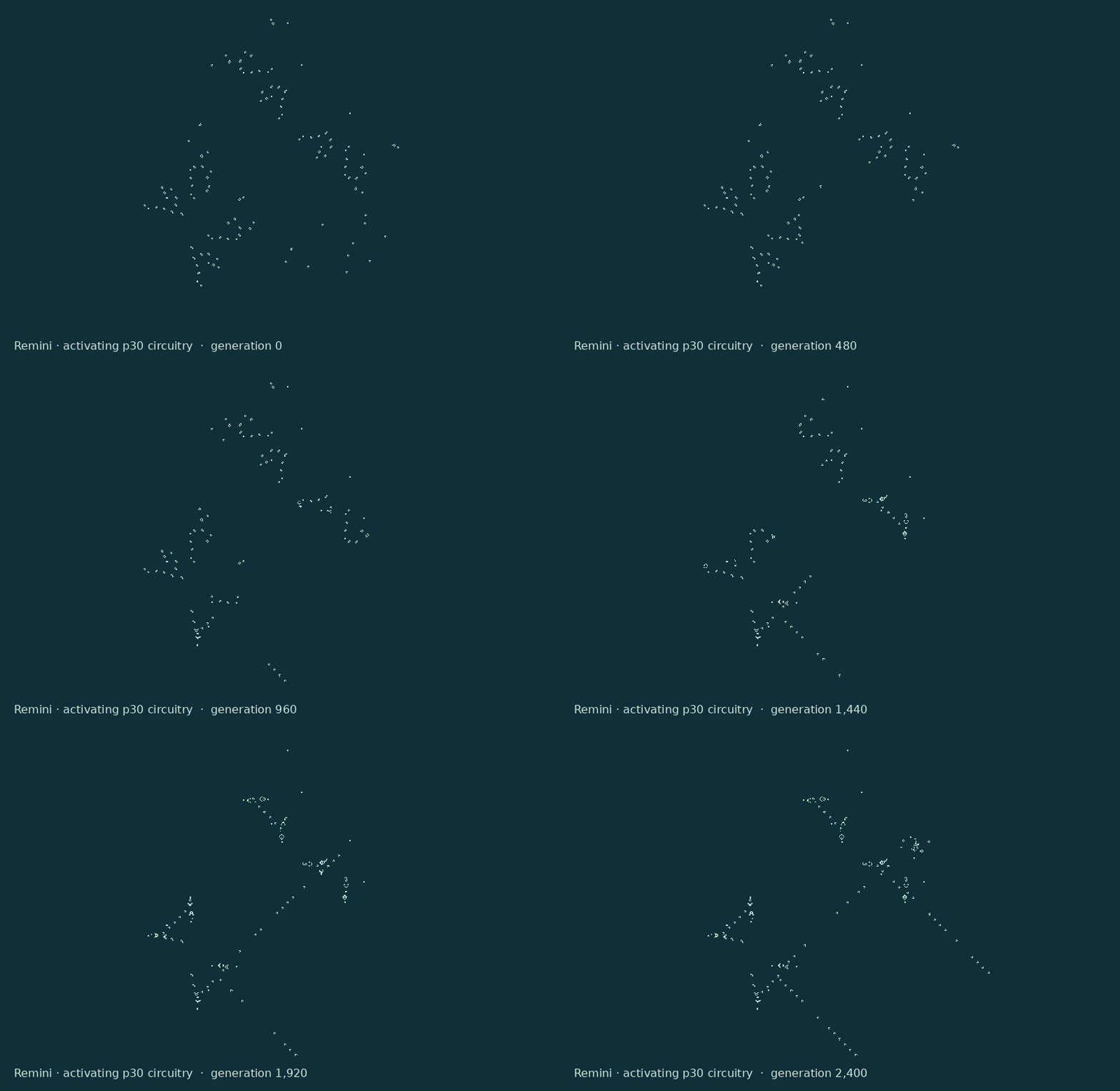
The animation follows the opening 2,400 generations of the original pattern. The still-life seeds turn into active period-30 circuitry as the triggering gliders arrive. The view stays on the first constructor; the much longer instruction tape continues outside the frame.
Building the constructor
The forum records the route from searched arm recipes to the assembled pattern. My search code found movements and glider outputs; scripts collected those recipes, and Remini.py combined them with construction instructions from slmake.
slmake, developed by Adam P. Goucher, supplied slow-salvo recipes for the seeds of the circuitry. Triggering the seeds turns them into the period-30 mechanisms. Synchronizing the two ends was a separate task: the April 13 attempt had a timing mismatch, followed by the working file on April 14.
What the pattern demonstrates
The significance is the combination: a modern construction method implemented with components available in the 1970s. Remini demonstrates that single-channel self-construction can be realized with that older toolkit. The gaps in a glider stream provide the control; stable Spartan circuitry is not required for this particular construction.
That is the reason for “Retro Gemini”: modern self-construction, classic components.
The completed example is a puffer, not a cleaned-up Gemini spaceship: it leaves earlier circuitry behind. The thread also explores a more ambitious “grey goo” search approach. That proposed direction should be distinguished from the arm-and-slmake construction used for Remini.
This is a very large pattern. LifeWiki links the downloadable macrocell file for the assembled example. Its listed period and speed are unknown; this article does not supply estimates for them.
Download the original Remini macrocell to inspect it in Golly. The source directory includes the search tools and assembly scripts; the original scripts contain local paths that need adjustment before reuse.
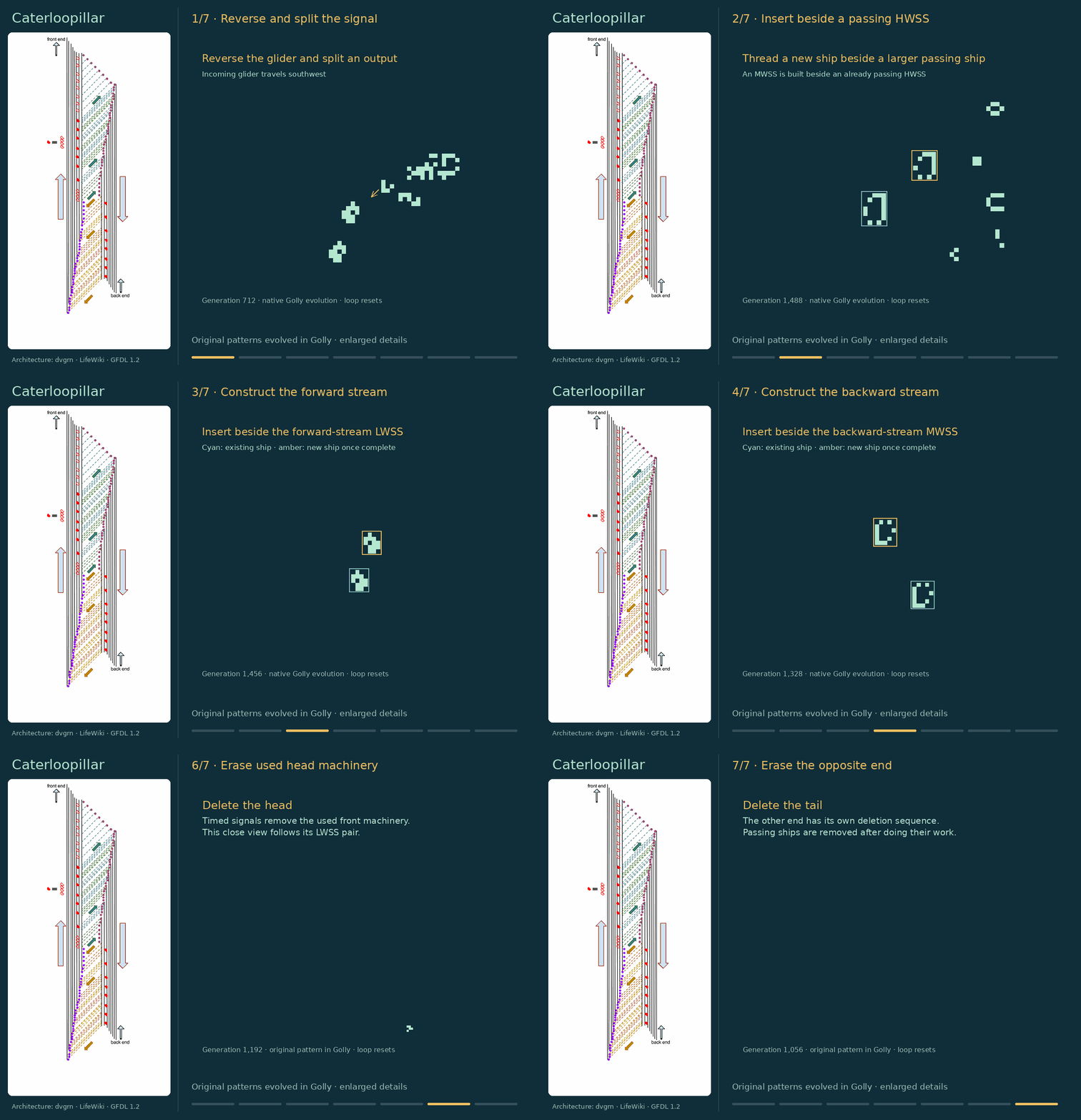
For another approach to patterns that construct their own moving machinery, see Caterloopillar.