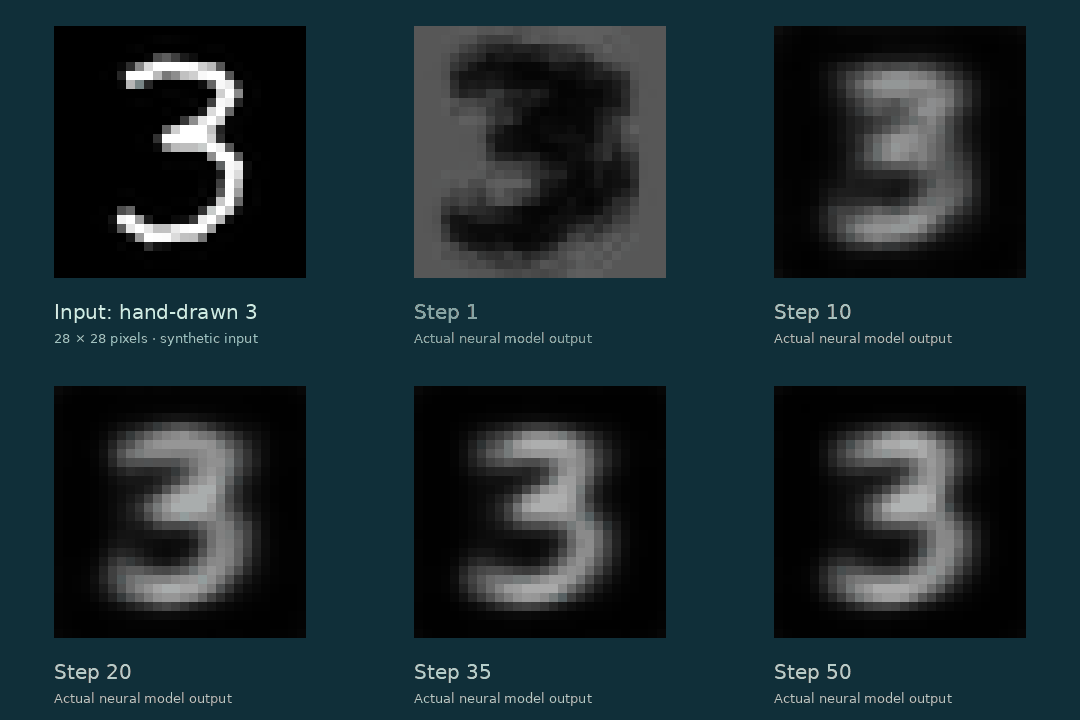
This experiment processes a handwritten digit through 50 spatially local neural updates. Each step produces another 28×28 image, making the computation visible as a sequence rather than only a final label.
The animation begins with a synthetic hand-drawn 3, represented as a 28×28 grayscale image. That is the input supplied to the published ONNX model. It stays visible for three seconds, followed by a faster sequence of the actual images at steps 1, 10, 20, 35, and 50. The numbered frames are selected updates, rather than every intervening step. This is one example of the evolving state, not an accuracy measurement.
Images as state
The README describes no separate hidden state vector. At step , the original input and previous output images are concatenated as channels. A local convolutional block produces the next image, squashed into by a sigmoid.
A schematic description is
The memory is the stack of produced images. The rule is step-specific: through are different learned updates.
Why it is CA-like
The process operates through local neighborhoods and repeated grid updates. It differs from a classic cellular automaton because the updates are learned filters and the same rule is not repeated at every step.
The README specifies local processing with radius four. That locality describes an update; information can still propagate across multiple steps.
What the demonstration shows
Draw a digit in the original app. The input is cropped, squared, and downscaled. The interface displays the 50 intermediate images, an animation, and a final digit verdict with a confidence score.
The verdict is a classifier’s output. The documentation does not provide a benchmark here establishing a general recognition-accuracy claim.
Training and inspection
The repository includes data preparation, training, local animation, and ONNX export scripts. The browser must load the ONNX model before Run becomes ready; the README suggests allowing roughly 30 seconds, though actual load time varies.