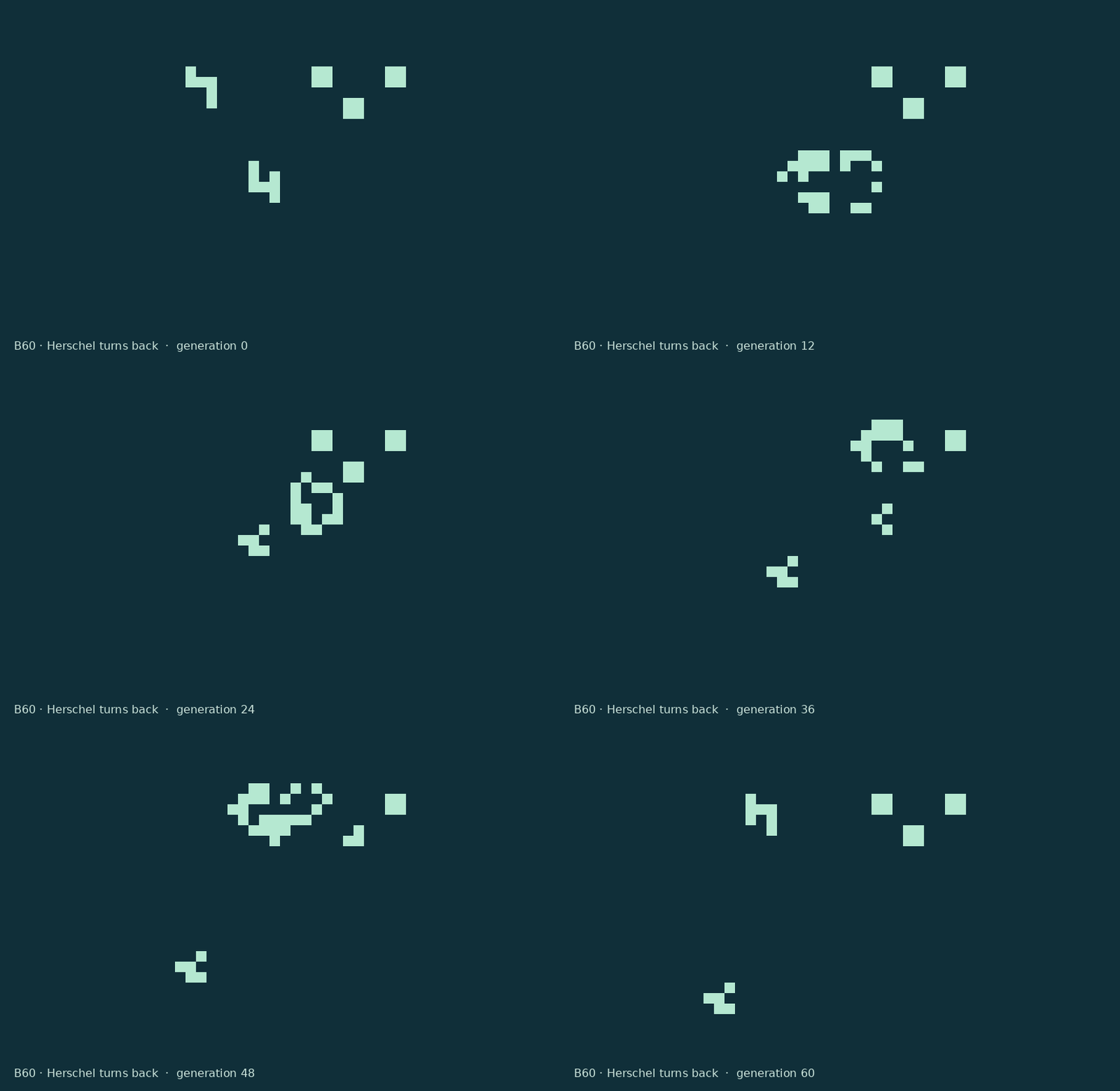
B60 is a Herschel conduit I discovered in 2015 using CatForce. Its catalysts are just three blocks: 12 stationary live cells supporting the reaction.
Sixty generations
A Herschel input interacts with the blocks. After 60 generations, the output is another Herschel rotated by 180 degrees, displaced by relative to the input.
The catalyst blocks recover. Their role is to redirect the reaction without being permanently consumed.
Closing the loop
Two copies of B60 can connect to one another. That closed loop underlies both the Simkin glider gun and Simkin’s p60.
The gun and oscillator handle the emitted gliders differently. In the oscillator, additional eaters remove gliders that would interfere with the next Herschel.
B60 connects the search infrastructure to a concrete result: a compact catalytic reaction that becomes a reusable circuit element. LifeWiki documents its orientation, timing, recovery constraints, and pattern.