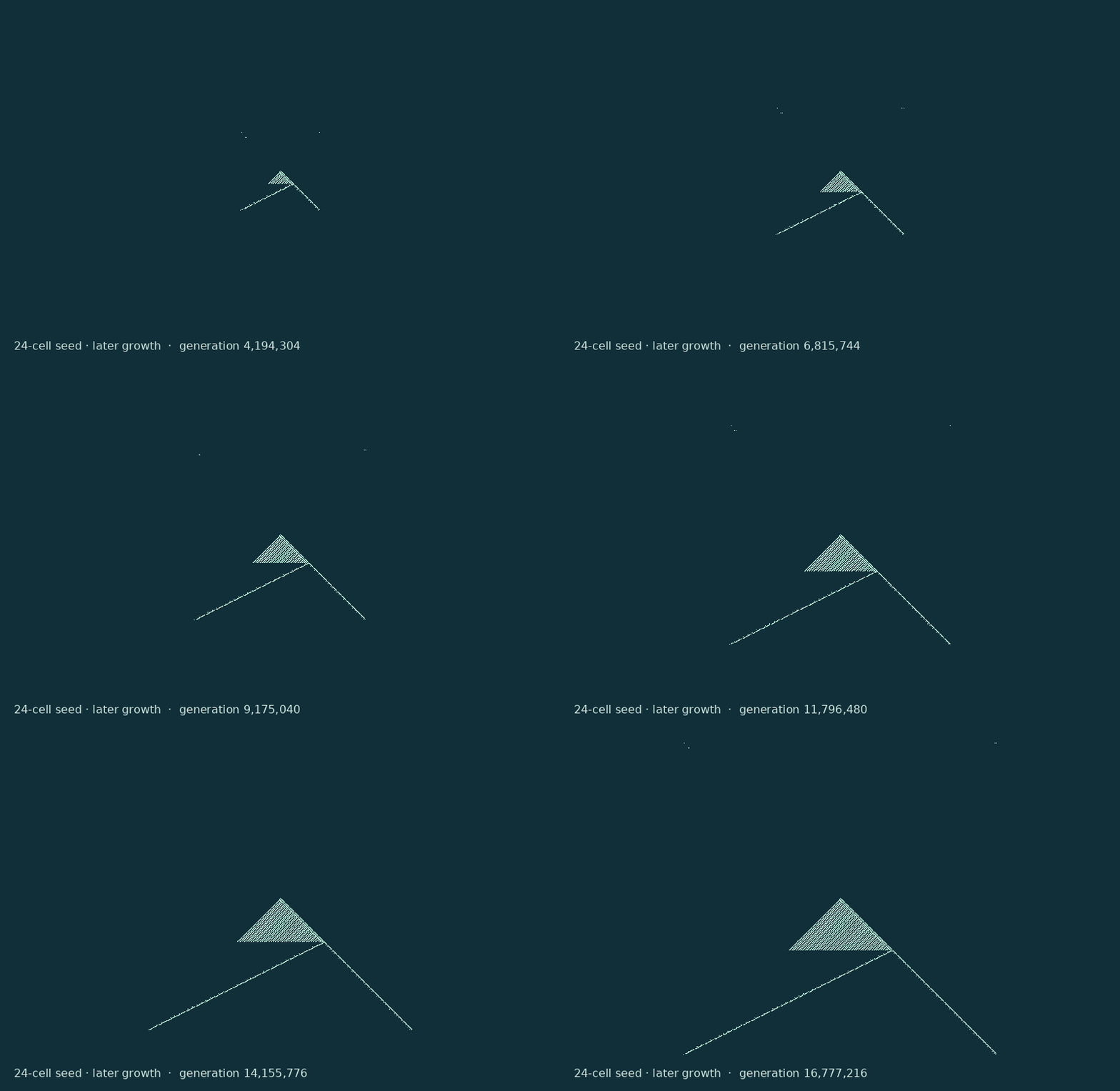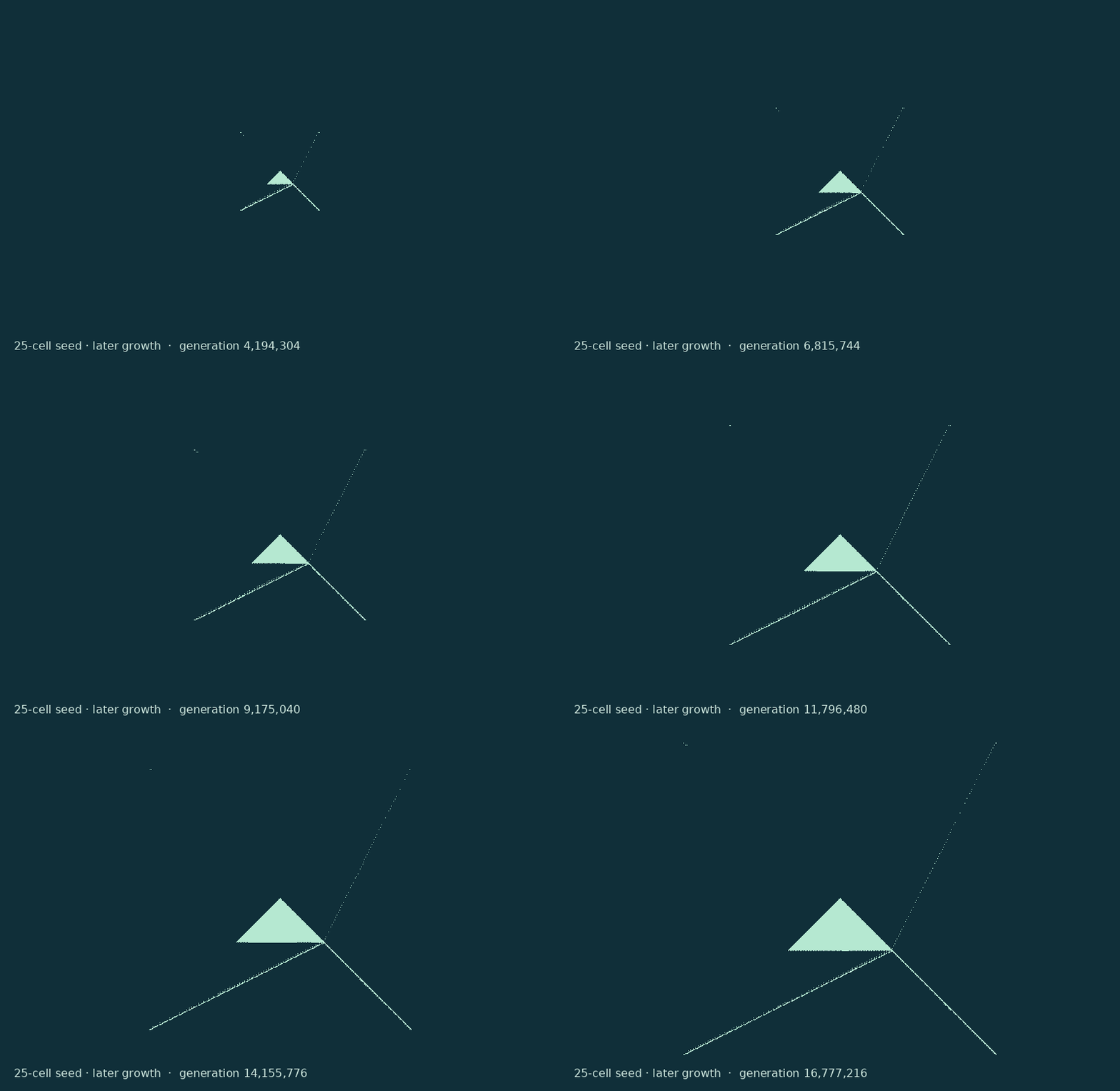
Switch engine ping-pong starts with 23 live cells. I found it on October 29, 2014, after finding 25-cell and 24-cell quadratic-growth seeds earlier that month. This was a new mechanism using only two switch engines, and its starting-population record stood for more than seven years.
Ping, pong, then ping again
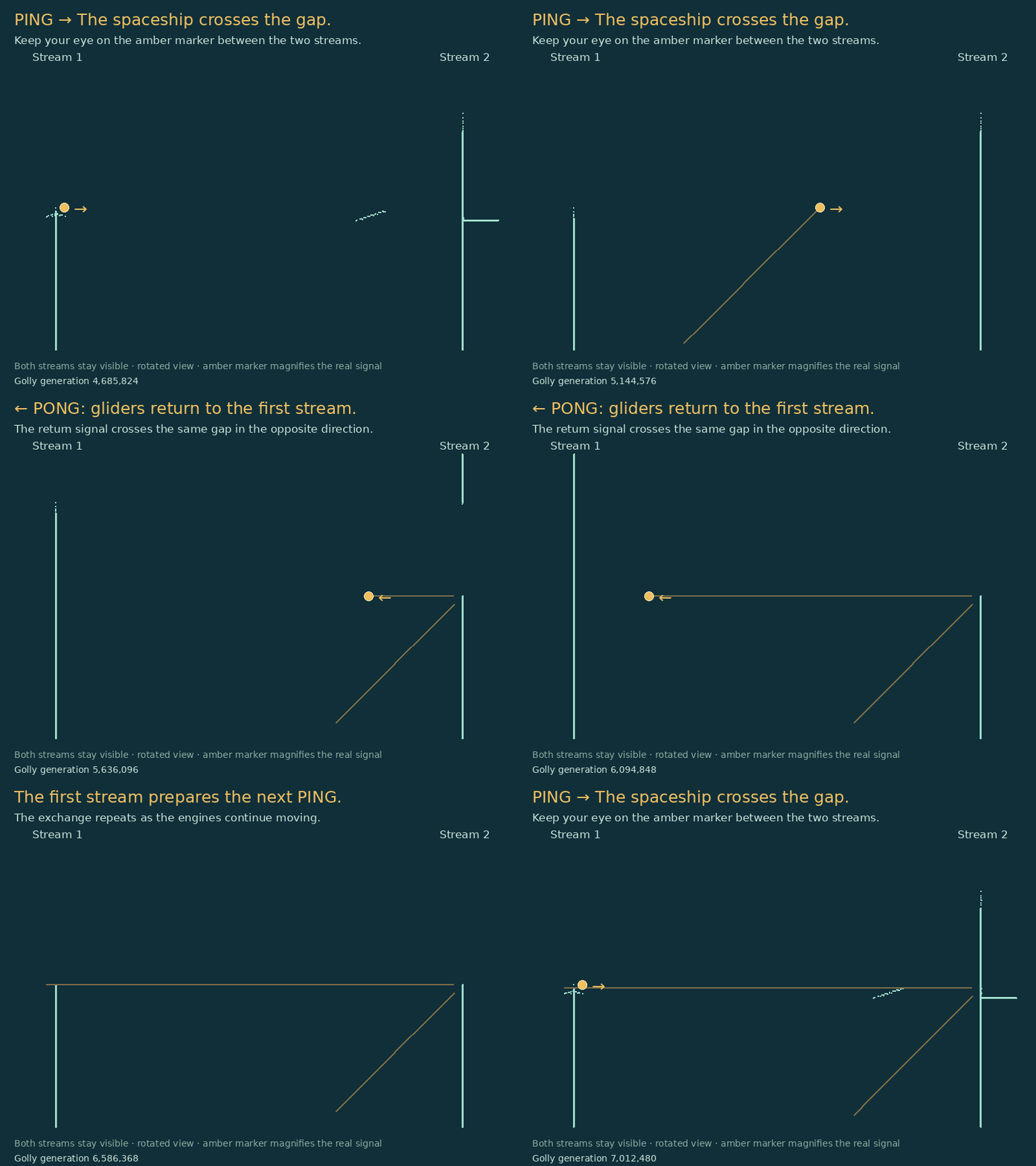
The cover keeps both streams and the whole gap in view. Follow the amber marker: a middleweight spaceship crosses from the first stream to the second (ping); gliders travel back toward the first stream (pong); then the next outward spaceship appears. Captions above the image pause when the direction changes.
These are actual Golly HashLife states of the original seed, from generation 4,685,824 to 7,012,480. The camera rotates the view 45 degrees and moves along the streams as the engines advance. It keeps the distance between the two streams fixed on screen. The amber signal marker is enlarged so a tiny spaceship or glider can be followed across the enormous gap; its position comes from detecting the actual cells. The clip resets after one complete exchange and the start of the next ping.

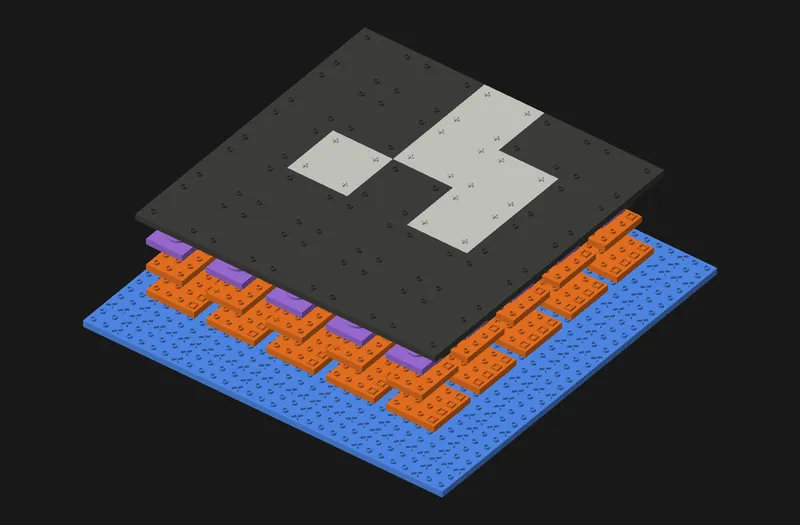
The starting seed, from LifeWiki, GFDL 1.2.
The initial seed includes gliders, an R-pentomino, an R-pentomino predecessor, and a pre-block. Their interactions produce two parallel switch engines and a middleweight spaceship. The repeated exchange interacts with the engines’ glider streams, producing further switch engines traveling in another direction.
This is a breeder: the evolving pattern keeps making additional growing components. Quadratic growth describes its long-term population, rather than a large initial pattern.
See the collision at the level of individual cells
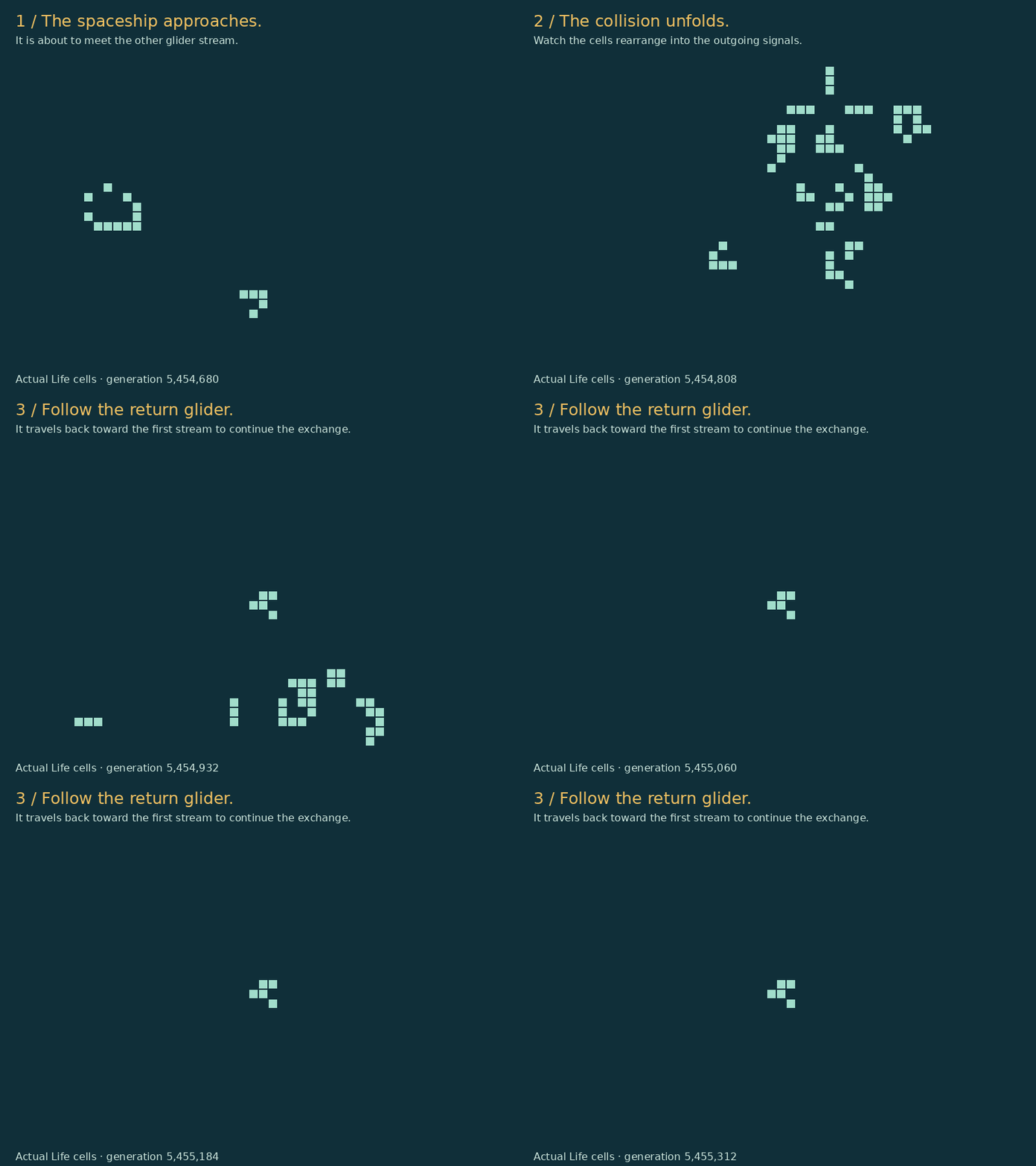
This detail samples every four generations from 5,454,680 to 5,455,312. The displayed crop matches a full-pattern Golly run. It shows the local reaction responsible for the change of direction in the overview.
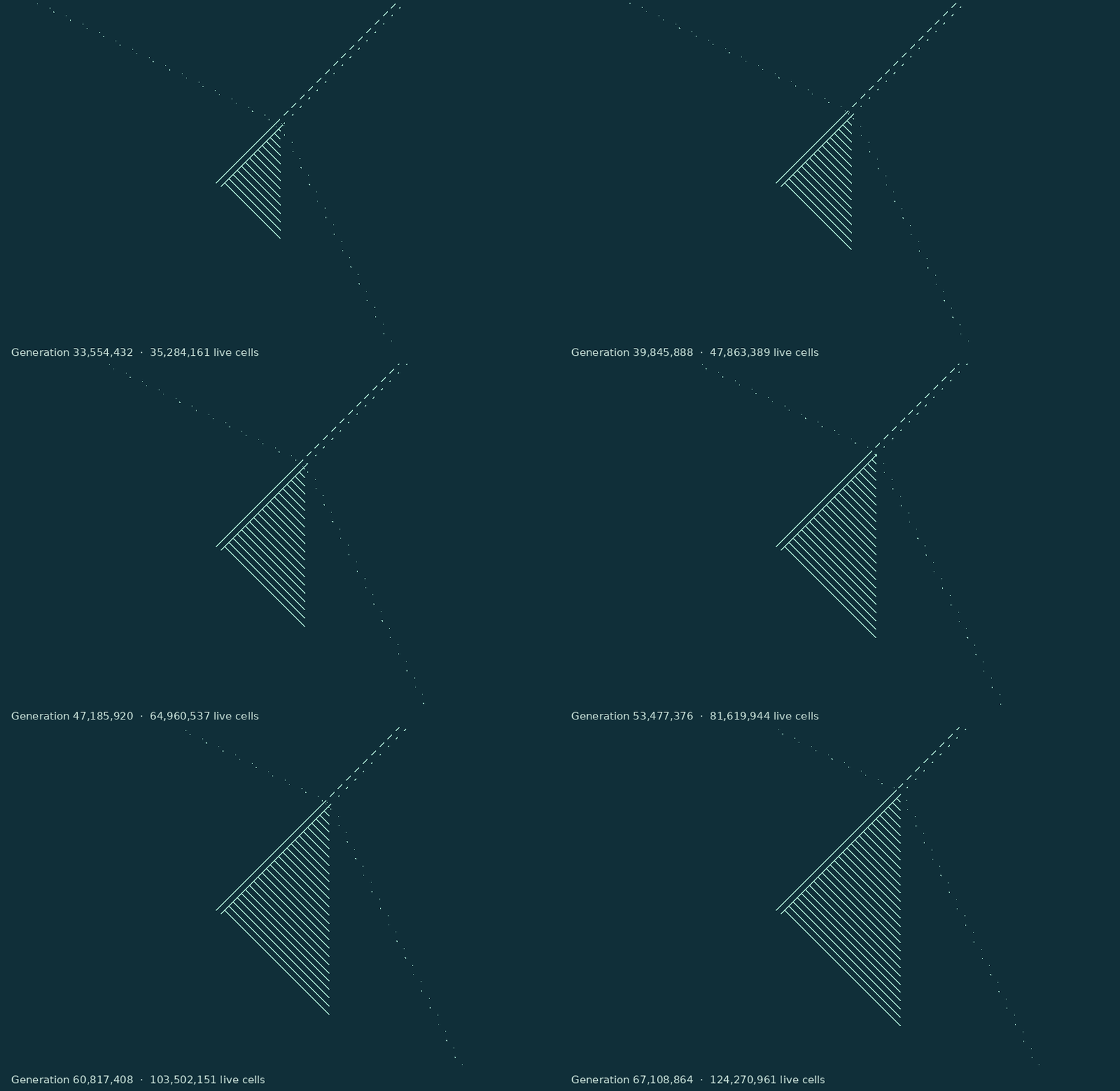
The resulting growth, shown separately at a much wider scale. This Golly run samples generations 33,554,432–67,108,864; the final full-pattern population is 124,270,961.
Why the gap is so large
The large gap comes from very carefully tuned distances between the two streams. The spacing has to make the outward and returning signals meet the streams in useful phases, repeatedly. Finding a distance that sustains the exchange was a central part of the discovery.
The resulting 23-cell seed occupies a 210,515 × 183,739-cell bounding box. The small starting population and the large physical extent describe different aspects of the construction. Getting the two-engine exchange to work made this a particularly memorable result for me.
A historical record
The LifeWiki record history dates Nick Gotts’s 26-cell pattern to March 17, 2006. My October 2014 discoveries broke a record that had stood for over eight years. Ping-pong then remained the smallest known starting population until March 12, 2022.
| Pattern | Discovery date | Starting cells |
|---|---|---|
| My 25-cell seed | October 21, 2014 | 25 |
| My 24-cell seed | October 23, 2014 | 24 |
| Switch engine ping-pong | October 29, 2014 | 23 |
| dani and David Raucci’s new record | March 12, 2022 | 22 |
| dani’s next improvement | March 15, 2022 | 21 |
| dani’s next improvement | April 4, 2022 | 20 |
LifeWiki currently lists the 20-cell pattern as the population record. These are historical records; ping-pong remains interesting for the repeated exchange that made its two-engine design work.
In my later response to the new discoveries, I welcomed the record being broken and the new mechanisms found through searches using apgsearch. Seeing more solutions was progress in our understanding of Life.